Research

From measurement to predictive control.

I study how short-lived physical events can be measured, interpreted, and controlled. Across laser-induced plasma, droplet dynamics, and multi-MHz OCT, I connect optical-system design, time-resolved measurement, quantitative reconstruction, physical modeling, and uncertainty assessment.

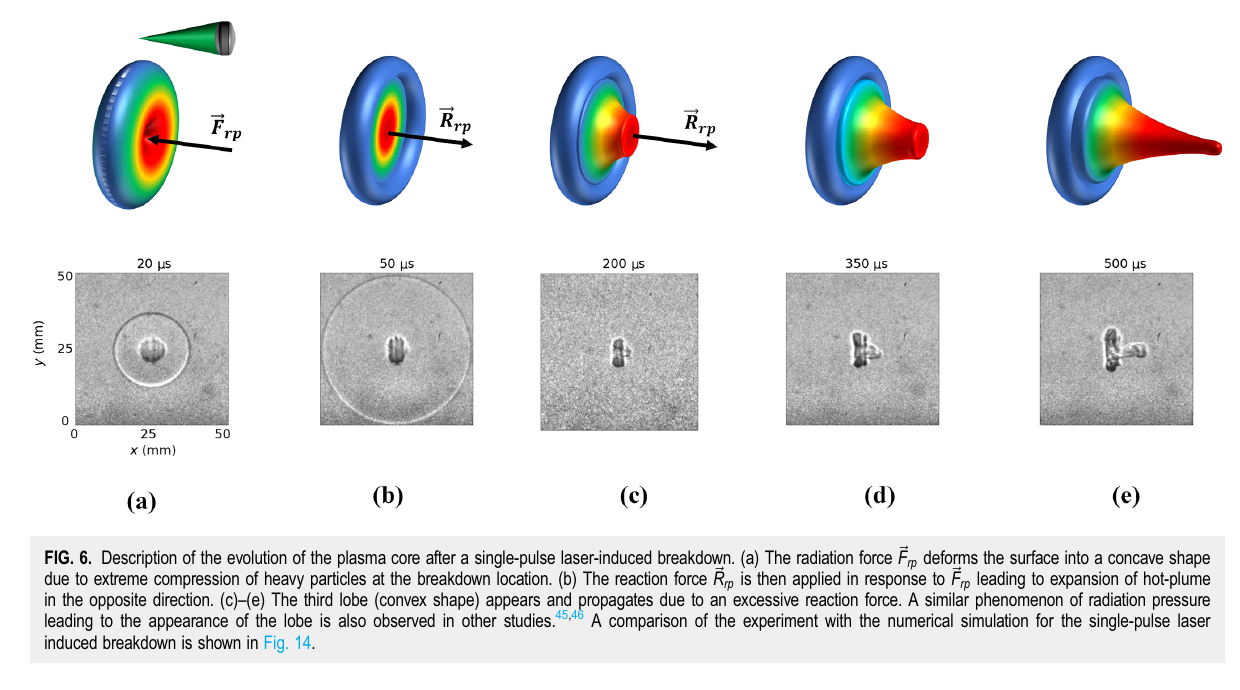
Journal of Applied Physics Figure 6 showing modeled and experimental evolution of a plasma core after single-pulse laser-induced breakdown.
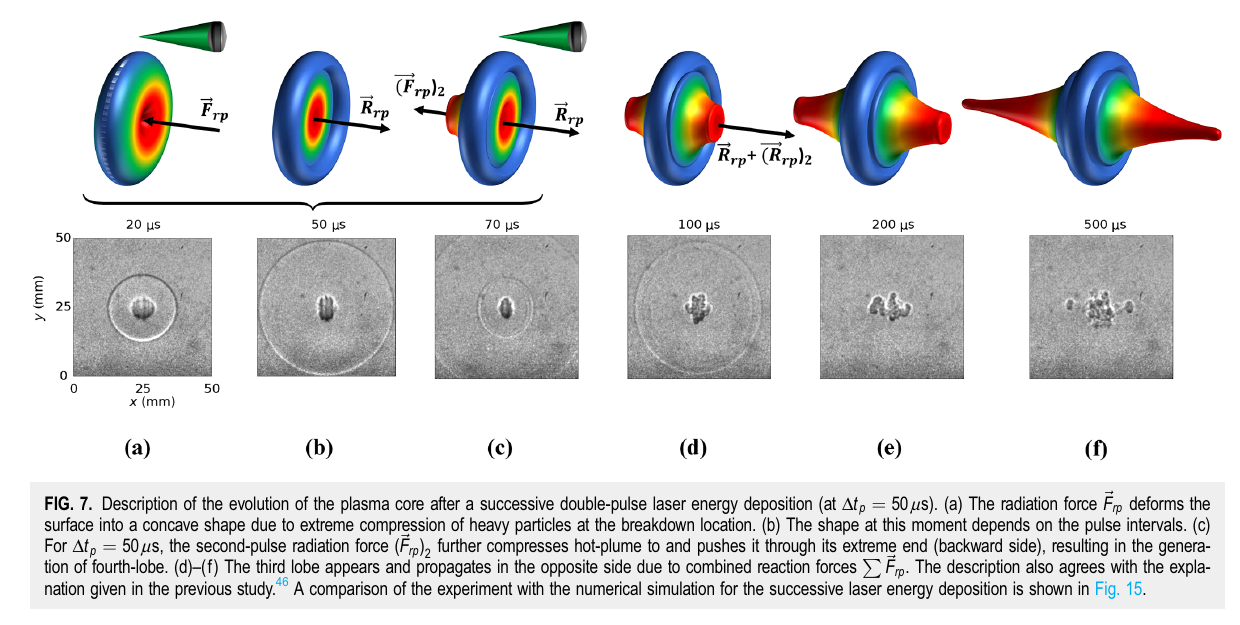
Journal of Applied Physics Figure 7 showing modeled and experimental evolution of a plasma core after successive double-pulse laser energy deposition.
Figures 6 and 7 from Insight into the evolution of laser-induced plasma during successive deposition of laser energy, Journal of Applied Physics (2022).

01

Laser energy deposition, plasma evolution, and ignition

Laser energy deposition creates a coupled sequence: optical breakdown, blast-wave formation, plasma cooling, mixing, and, under suitable conditions, ignition. I study that sequence with high-speed Schlieren and spray imaging, absorbed-energy measurements, finite-volume simulations, thermochemistry, and radiation modeling. Producing a breakdown spark is not by itself sufficient for ignition: spatial placement, hot-kernel lifetime, pulse timing, and heat loss determine whether the deposited energy produces a sustained response.

Role in this theme

This theme includes my first-author Applied Energy study and Ph.D. work on experimental-facility development, high-speed optical diagnostics, and laser-ignition analysis.

  • Laser-induced breakdown and plasma-kernel evolution
  • Single- and double-pulse energy deposition
  • Atomized fuel-air ignition
  • High-speed shock-wave tracking
  • Ph.D. thesis: facility, acquisition, and analysis development
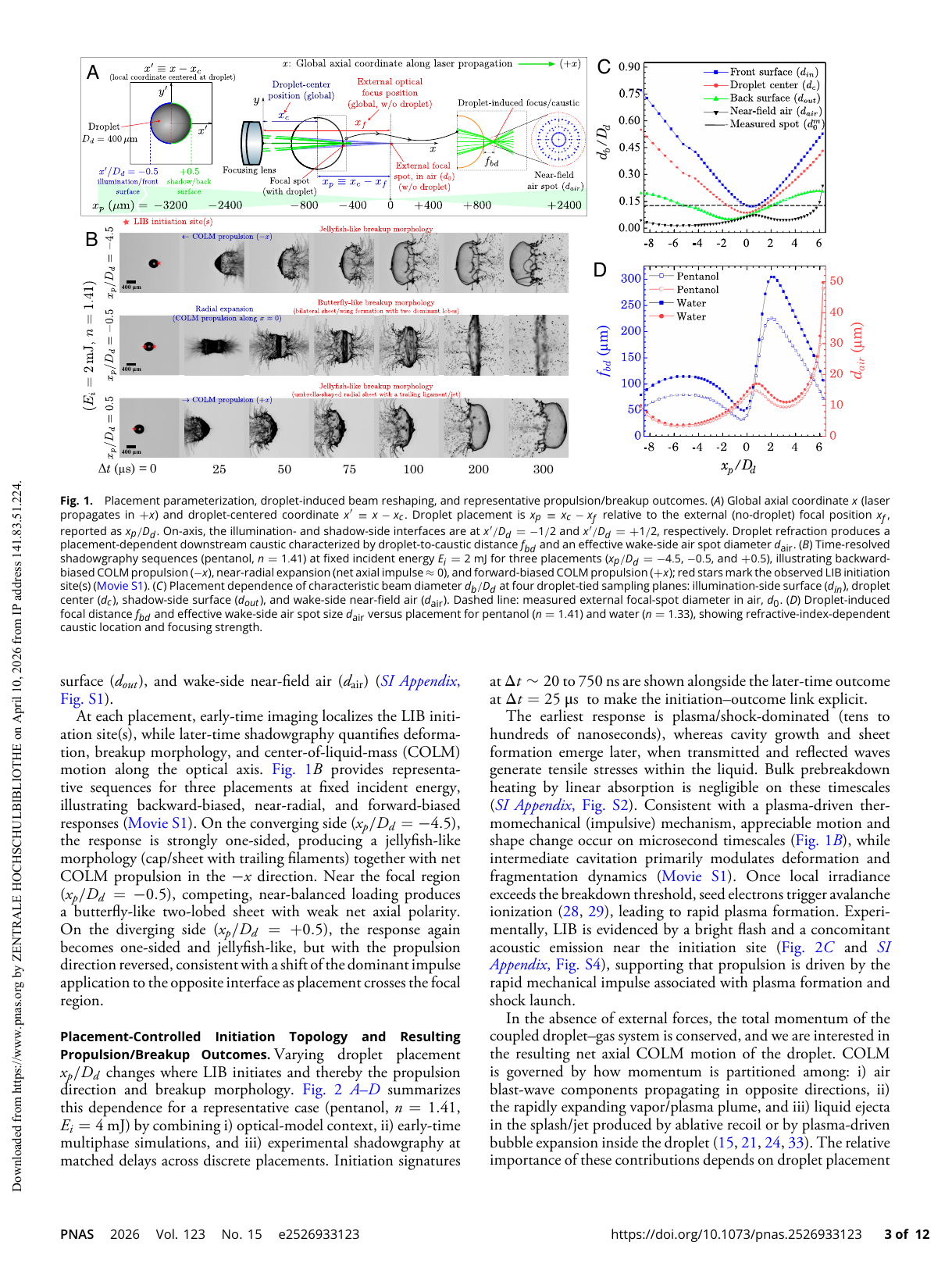
Optical placement diagram and time-resolved shadowgraphs showing laser-driven droplet responses.
Figure source: Predicting and controlling laser-induced breakup and multidirectional propulsion of liquid droplets, PNAS (2026).

02

Droplet dynamics under vortex, shock-wave, and laser forcing

Short-duration pressure and vorticity impulses can deform, accelerate, and fragment droplets across distinct regimes. My work spans co-axial vortex-droplet interaction, shock-induced aerobreakup, laser-driven fragmentation of droplet arrays, and predictive control of single-droplet propulsion. The current emphasis is to connect calibrated forcing conditions and measured uncertainty with physically interpretable response maps.

Role in this theme

This theme includes my first-author PNAS study and an equal-contribution role in the 2022 droplet-array paper.

  • Shock-droplet and vortex-droplet interaction
  • Laser-driven propulsion and fragmentation
  • High-speed shadowgraphy
  • Aberration-aware optical modeling
  • Placement-energy maps and uncertainty propagation
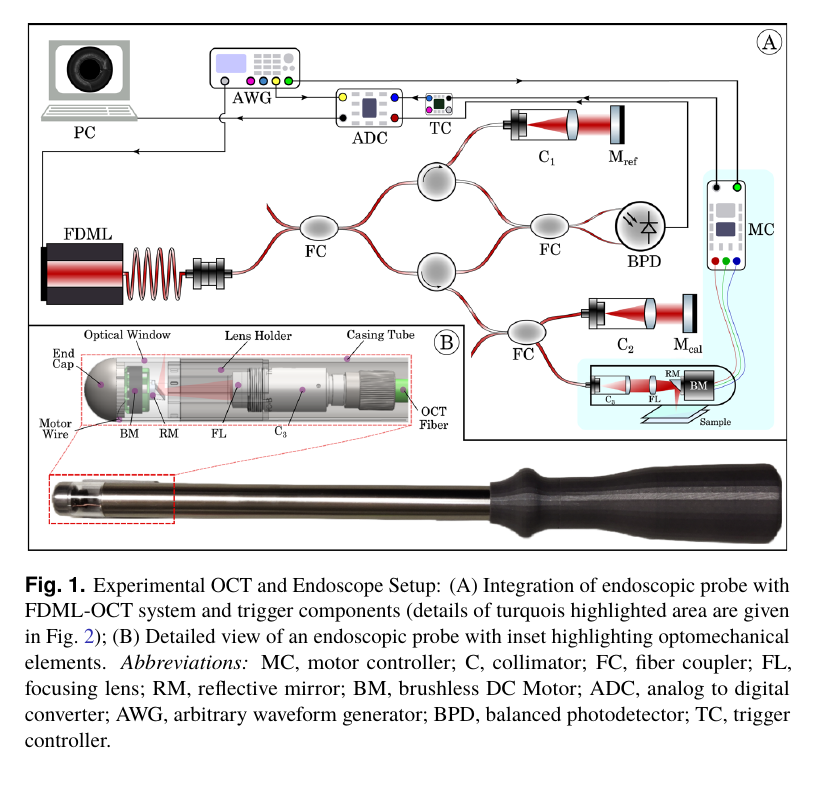
Optics Express Figure 1 showing the multi-megahertz OCT system, synchronization components, and endoscopic probe.
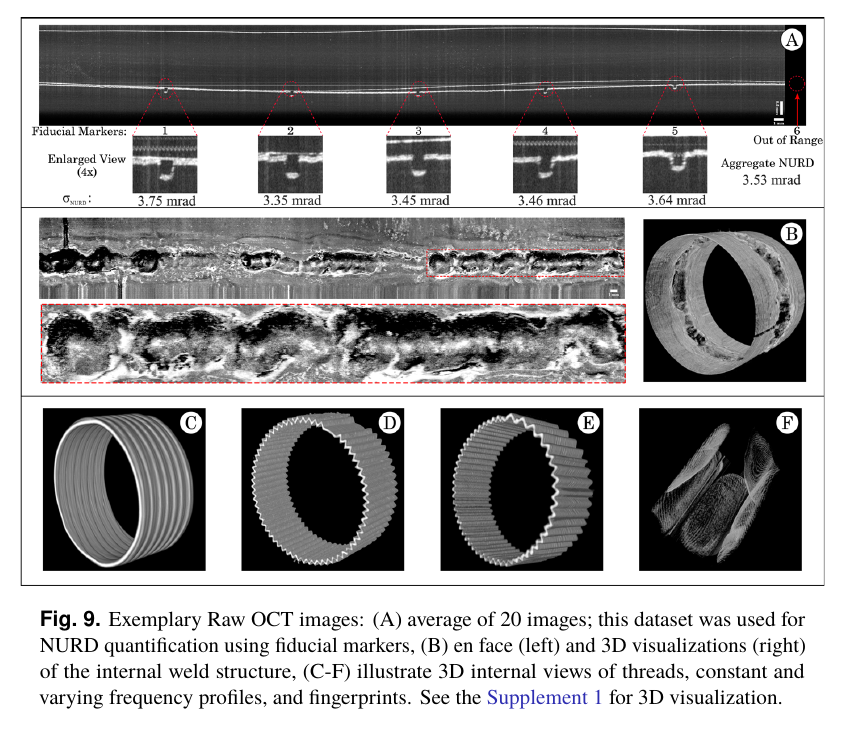
Optics Express Figure 9 showing raw OCT images used for distortion assessment and three-dimensional imaging examples.
Figures 1 and 9 from Virtual Hall Sensor Triggered Multi-MHz Endoscopic OCT Imaging for Stable Real-Time Visualization, Optics Express (2024).

03

Multi-MHz OCT endoscopy and biomedical optical systems

My biomedical-optics work focuses on multi-megahertz OCT endoscopy and the engineering required for stable imaging. The published evidence covers prototype instrumentation, model samples, ex vivo and postmortem tissue, and low-latency visualization; it does not imply demonstrated clinical diagnostic performance.

Role in this theme

The 2024 Scientific Reports paper records my contribution to probe design and development and experimental investigation; my first-author Optics Express study focused on sensorless rotational synchronization and imaging stability.

  • FDML-based multi-MHz OCT
  • Fiber and free-space optical design
  • Probe and optomechanical development
  • Sensorless rotational synchronization
  • Image quality, timing, and distortion analysis

Methods

A connected technical toolkit

The exact stack changes with the problem. The standard remains the same: traceable assumptions, quantitative evidence, and reproducible analysis.

Optics

Zemax OpticStudioOCTFDML lasersGaussian beam propagation

Experiment

High-speed imagingSchlierenShadowgraphyPIVPLIF

Computation

C++20PythonMATLABMPIFinite-volume CFD

Engineering

SolidWorks3D printingSensorsMotorsSystem integration

Validation

Uncertainty propagationParameter mapsError analysisBenchmark cases

Next

See the research record

Journal articles and proceedings are maintained separately, with independent numbering and direct links where available.

Browse publications